Fortem: A Control Plane for Teams Running a Fleet of ECS Fargate Environments
Terraform is great at standing an environment up. It has nothing to say about what happens next. Once a team is running ten, twenty, fifty ECS Fargate environments, a second set of problems appears that infrastructure-as-code was never meant to solve: the non-prod environments burning money overnight, the staging clone someone needs in the next ten minutes, the simple question of what is even running across all the accounts and regions right now.
That's the operations gap. Most teams fill it with six months of Lambda glue and a platform engineer's patience.
Fortem is that operational layer, built.
What Fortem does
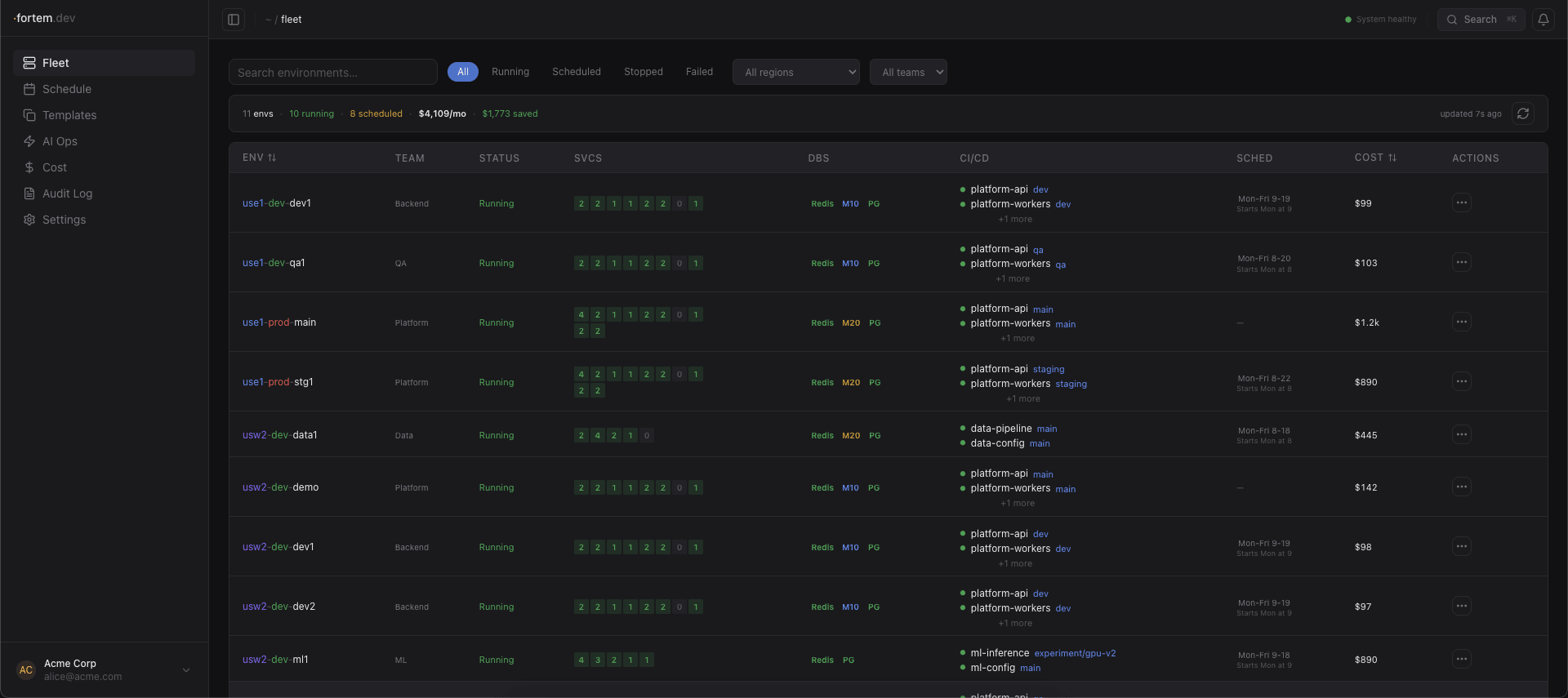
Fortem is a control plane for engineering teams running 10+ AWS ECS Fargate environments. It sits above your existing setup — no migration, no agents — and gives you three things infrastructure-as-code doesn't: schedule non-prod environments to stop at night and start before the team logs in, clone a full environment in about 30 seconds, and see everything running across the whole fleet in one view.
It works with your current ECS, reads your AWS resource tags for configuration, and runs entirely inside your own AWS account — your data never leaves it.
What's broken about the alternative
The gap opens precisely when Terraform stops being enough. IaC defines and provisions environments beautifully. It does not turn them off at 7pm, it does not give a developer a safe button to restart their own service, and it does not produce a single pane of glass across accounts. Those are runtime operations, not provisioning.
So platform teams build the missing layer by hand. A Lambda to stop tasks on a schedule. Another to start them. A tagging convention nobody fully follows. A Slack bot for restarts. A spreadsheet, or a Cost Explorer tab, standing in for fleet visibility. Each piece is small; together they're a multi-month project that becomes its own maintenance burden — and until it's built, non-prod environments run 24/7 whether anyone's using them or not.
Two costs come out of that gap. The obvious one is AWS spend: dev and staging fleets running around the clock for environments only needed during business hours. The quieter one is the platform team itself, turned into a ticket queue for restarts, redeploys, and "can you spin me up a staging copy."
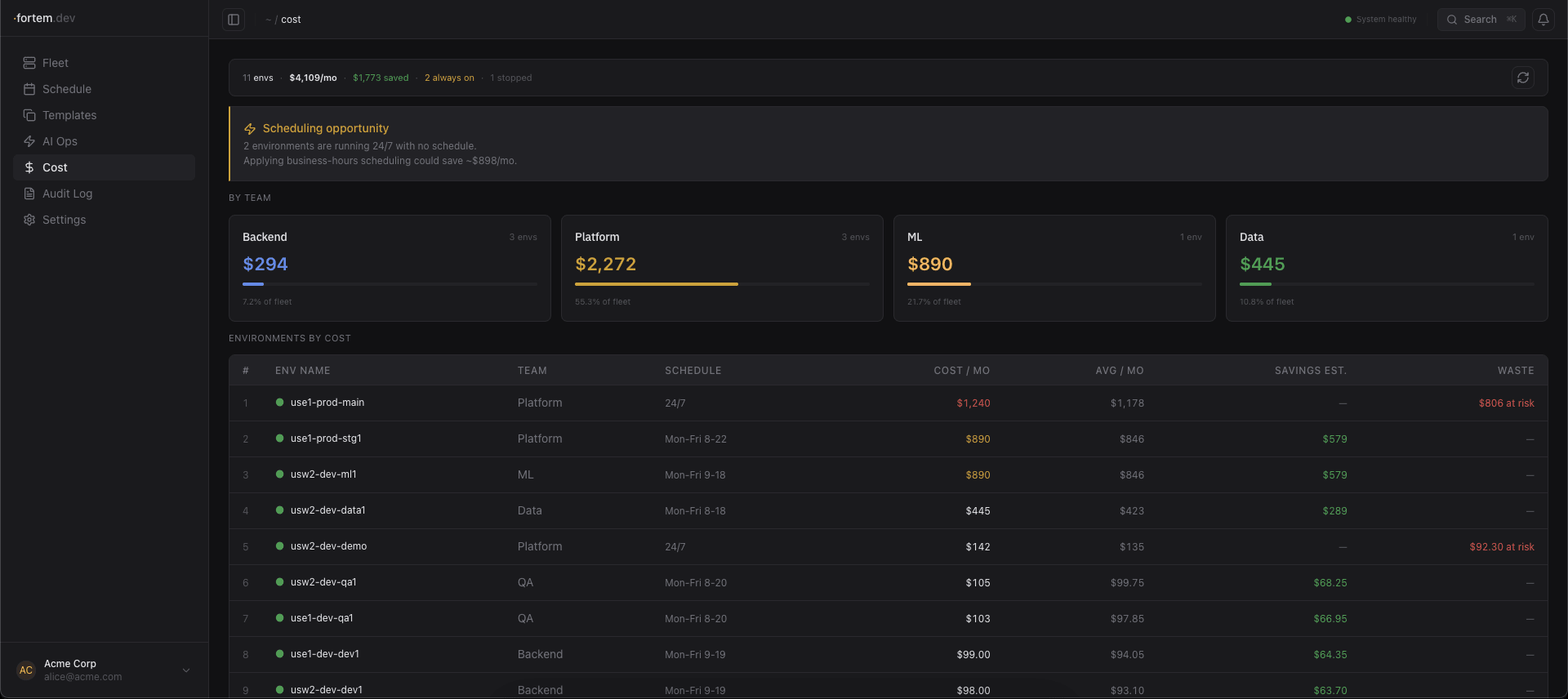
Fortem closes both. Scheduling stops the overnight burn. Self-service hands routine operations back to the developers who need them. The fleet view replaces the spreadsheet. It's the layer the platform team would have built anyway — without the six months.
How it works
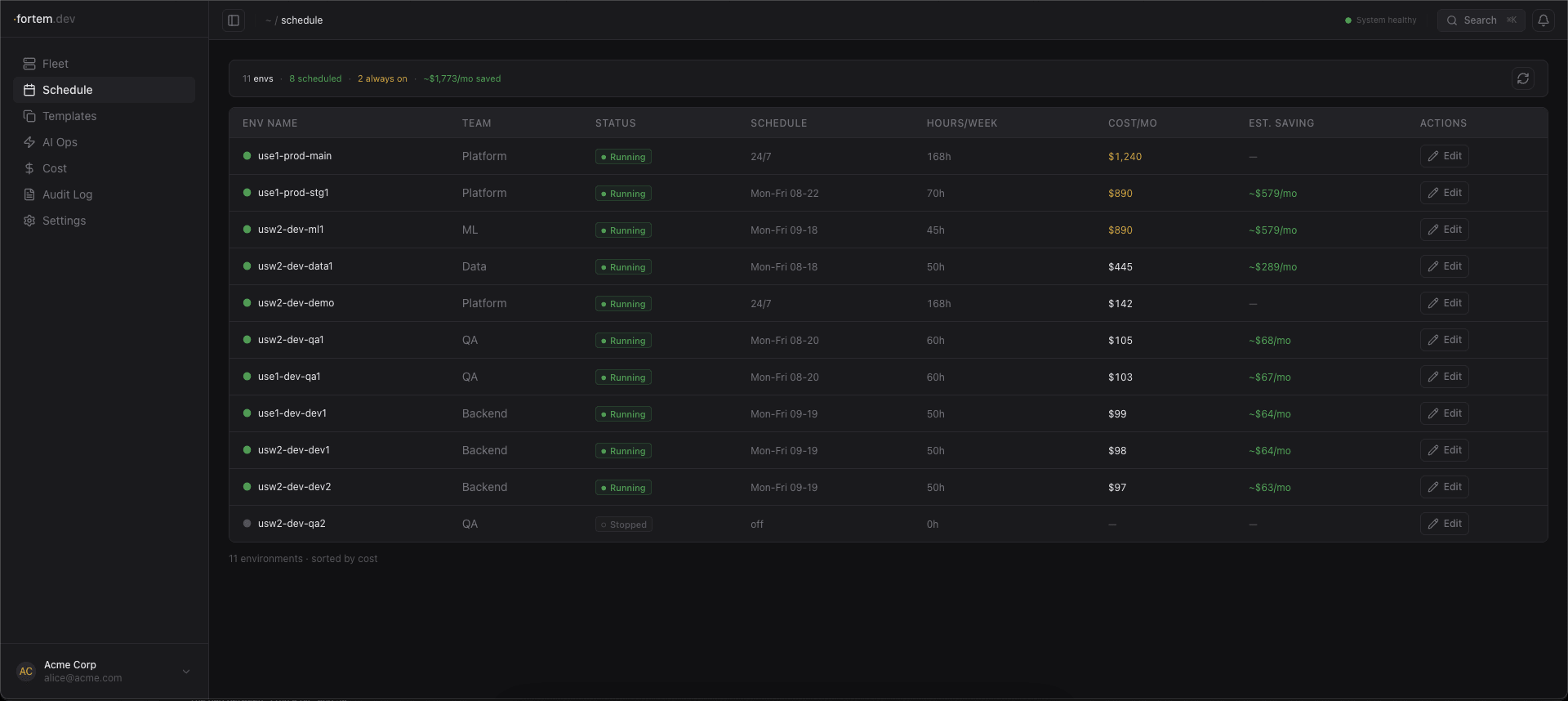
Environment scheduling — Run each environment only during the hours it's needed, per timezone, weekends off by default (e.g. Mon–Fri 9–19). The overnight and weekend burn on non-prod simply stops.
Unified fleet view — One dashboard across regions and accounts showing every environment's status, cost, owner, services, databases, and CI/CD branch, with real-time cost tracking. The answer to "what's running?" in one place.
One-click environment cloning — Duplicate a full environment in about 30 seconds, so a fresh staging copy isn't a half-day of setup.
Developer self-service — Developers restart, redeploy, and view logs for their own environments, scoped by role-based access control. No tickets, no waiting on a platform engineer.
Diagnostics that propose, you approve — Fortem watches the fleet for idle environments and failing tasks and proposes fixes (a flagged environment with no deploy in 41 days; an ECS/IAM suggestion seconds after a task fails). Every state change requires human approval — it surfaces and suggests, it doesn't act on its own.
Who this is for
Engineering and platform teams running a real fleet of ECS Fargate environments — roughly 10–15+ — where per-environment cost and visibility have started to matter, and where the overnight non-prod spend and the restart-ticket queue have both become real. It assumes you already run ECS; it layers on top rather than replacing anything.
It works alongside Terraform, CDK, and your existing IaC, reads AWS tags, and supports Parameter Store and Secrets Manager for environment variables. Onboarding is managed by a Fortem platform engineer, and there's a free, read-only fleet audit that analyzes your actual AWS costs in about 15 minutes.
Pricing is freemium-to-paid: Starter at $790/month (up to 20 environments, scheduling and diagnostics), Scale at $2,490/month (up to 80 environments, RBAC/SSO, templates), and custom Enterprise. The framing the team uses: it tends to pay for itself in month one from the scheduling savings alone.
Try it
Run a free Fortem fleet audit — or see the Fortem listing on ShipBoost for category context.